When Museums Become Muses
Picture an artist standing alone in the Bardo Museum, sketchbook in hand, lost in conversation with 2,000-year-old Roman mosaics. Not as a tourist. As a researcher. A detective. A storyteller gathering fragments of forgotten narratives.
This is Olga Malakhova — Estonian-born, Tunisia-naturalized, Paris-educated. For over three decades, she’s been doing something extraordinary: transforming archaeological research into living art.

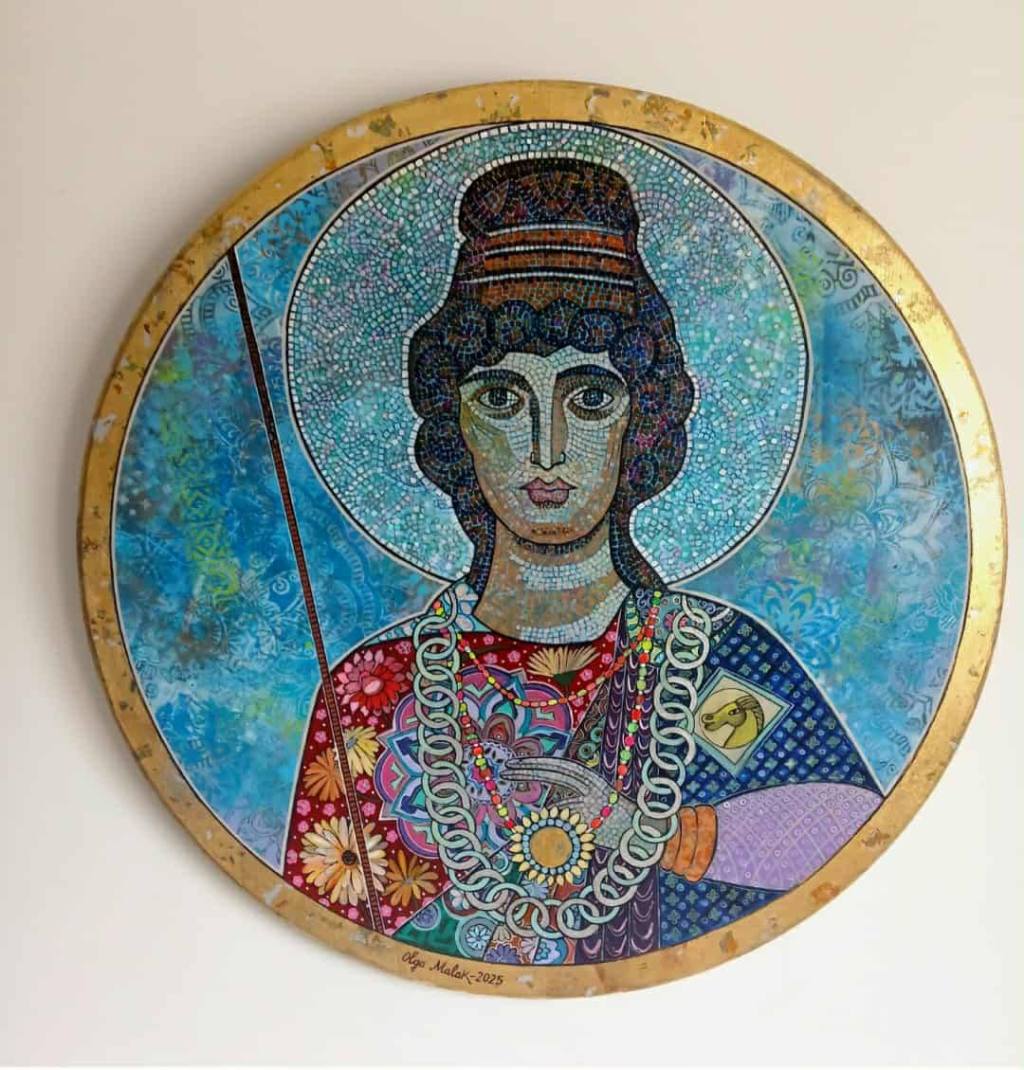
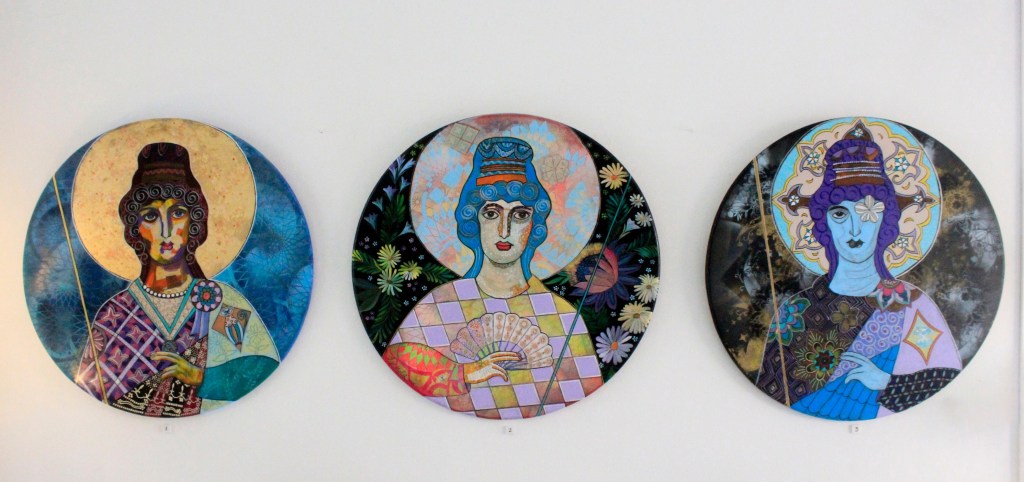
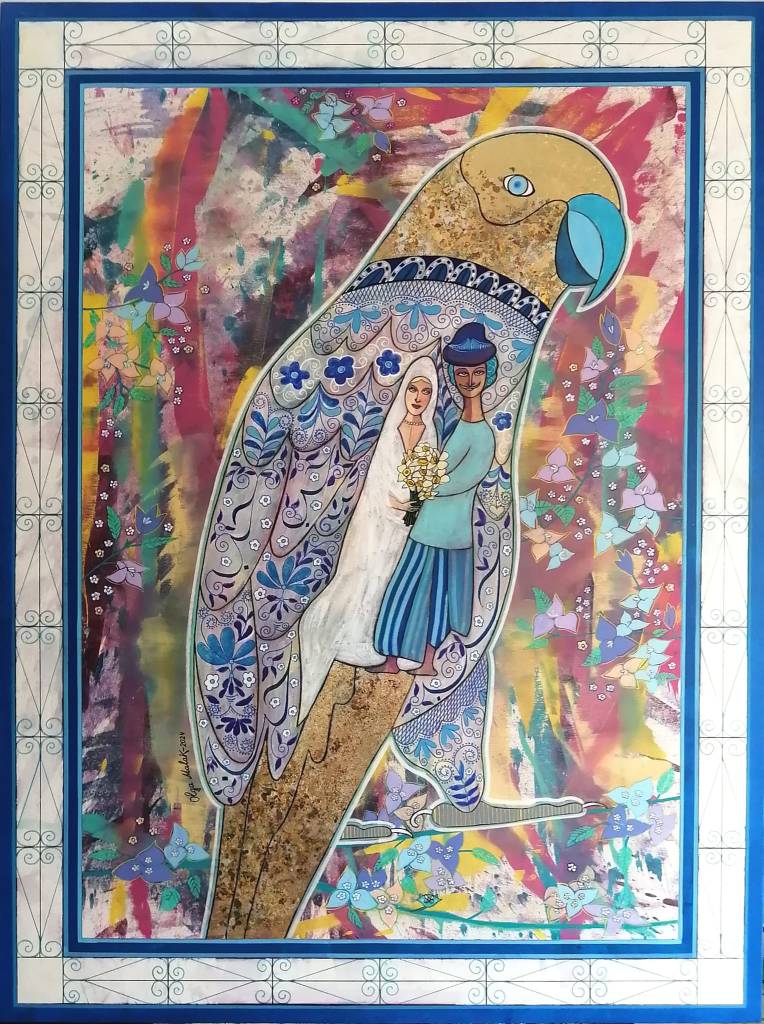
Working in acrylics and mixed media, sometimes enhanced with gold leaf in the Byzantine tradition, Malakhova creates narrative paintings that bridge millennia. Her canvases don’t just depict Tunisia’s heritage — they retell its founding myths, celebrate its continuity, and preserve collective memory through meticulous visual storytelling.
Critics place her work within Tunisian naïve art, yet she brings doctoral-level scholarship and systematic museum research to every composition. The result? An art form both spontaneous and deeply scholarly, joyful yet historically precise.
From Tallinn to Carthage: An Unlikely Journey
An Artist Born into Art
Tallinn, Estonia. Medieval spires. Baltic light.
Olga Malakhova grew up surrounded by creativity. Her father, Stanislav Malakhov (1935-2019), was a renowned landscape painter from the Saint Petersburg school. Her grandfather painted before him. Her mother was an artisan glassblower.
At five years old, little Olga accompanied her father on plein air sessions, learning to observe natural light with precision.
« A painter doesn’t see with their eyes, but with their spirit, » she says today — a maxim that guides her entire practice.
Academic Rigor Meets Creative Vision
After university studies in Leningrad (now Saint Petersburg), where she mastered classical painting techniques, Malakhova pursued an unusually scholarly path for a visual artist:
Master’s degree in Fine Arts, Gabès — Research on Tunisian landscapes and pictorial space
PhD in Aesthetics, Sciences and Technologies of Arts — University of Paris 8
Doctoral thesis: From Painting to Installation: The Construction of Landscape in Tunisia, from Colonial Era to Present (Published by ANRT, France)
This erudite foundation informs an artistic practice where chromatic sensitivity meets documentary depth, where theoretical research on heritage feeds innovative plastic creation.
She has also published several scientific articles and edited the collective work Heritage and Contemporaneity: An Identity Equation in Cultural Production (350 pages, Official Printing House of the Tunisian Republic, 2015).
The Tunisia Connection
1987: Malakhova’s first visit to Tunisia
Early 1990s: She settles in Gafsa, southern Tunisia, gateway to the desert
20+ years: Deep immersion in the ochre mountains and oases
Present: Based in Carthage, the legendary ancient site
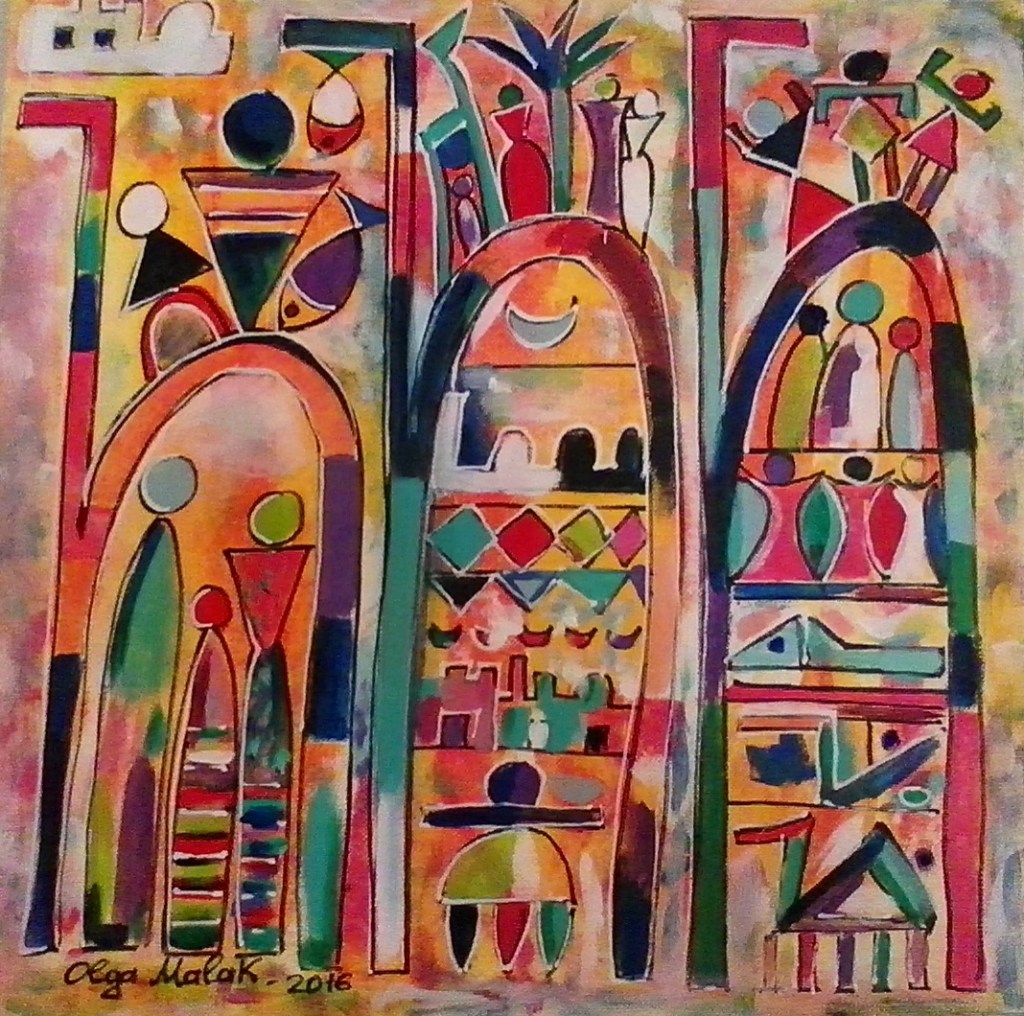
This long southern immersion profoundly marked her chromatic palette and formal vocabulary. She acknowledges the decisive influence of Hmida Waheda, an artisan who developed traditional Gafsa crafts, as well as ancient Amazigh symbolism, geometric Berber art patterns, and local weavers perpetuating centuries-old know-how.
Now a naturalized Tunisian citizen, Malakhova is candid about her attachment: « I love returning to Tallinn and Leningrad, I love Paris too, but I remain deeply in love with Tunisia, its incomparable light and patrimonial treasures. »
The Research Method: Museum as Studio
A Scholar’s Approach to Painting
What fundamentally distinguishes Malakhova from other contemporary artists is her methodology as researcher-storyteller.
« I regularly go to the Bardo Museum and find a multitude of details that fuel my imagination, » she explains.
Her museum visits aren’t casual gallery strolls. They’re systematic research sessions:
📝 Sketchbook documentation
🔍 Meticulous study of iconographic details
📚 Consultation of specialized publications
🏛️ Regular visits to multiple museums (Bardo, Sousse)
🗿 Analysis of archaeological sites
What She Studies
Roman mosaics at the Bardo — Particularly the famous Virgil and His Muses mosaic, which she considers among her major subjects
Ancient terracotta figures — Venus representations in various poses
Punic steles — From the Carthaginian Tophet
Ceramics — From the Sousse museum
Architectural details — Often overlooked by non-specialist eyes
« Sometimes in my daily life, a detail catches me and triggers my imagination, » she explains.

Building Visual Narratives
« I told my own stories thanks to these details. I have an overflowing imagination, and I dream a lot at night. »
Her creative process combines:
- Scholarly documentation
- Narrative imagination
- Mythological reinterpretation
For her major work « Lady Elyssa » (acquired by the Tunisian State), she explains:
« I started with a bridge, then I saw her tilted head in the shape of the bridge, then I thought of the Gafsa circus that I admired at the Bardo Museum, with its spectators to whom I added women. »
This description reveals her method: start with a formal element, associate documented heritage references, then construct an original visual narrative.

The Evolution: From Landscape to Legend
Early Period (1988-2000): Following Father’s Footsteps
Malakhova’s first exhibition in Tunisia dates to 1988, presenting landscapes. Her debut show was titled « On the Trails of Gafsa » (1987), marking the beginning of her personal style.
During this initial period, she explored Tunisian landscapes with:
- Classical academic eye
- Refined figurative touch
- Particular attention to natural light effects
The Revelation (2000-2015): Finding Her Voice
« I took 25 years to assert my style, which people say is very recognizable now. »
After 2015, at an age when many artists repeat themselves, Malakhova underwent a radical metamorphosis — from classical figurative landscape to dense symbolic narration.
This transformation was accompanied by a symbolic signature change: from « Olga Malakhova » to « Olga Malak, » marking a conscious stylistic rupture before returning to her full name.
« For three years my paintings bore the signature ‘Malak.’ I wanted to emphasize an evolution, almost a rupture. My new collections attempt to invest different universes and present innovative artistic research. »
Current Period (2015-Present): Permanence as Narrative Thread
Since 2015, Malakhova has affirmed her role as visual storyteller exploring the permanence of Tunisian traditions across centuries.
Unlike politically engaged or contestatory art, her work celebrates continuity, transmission, and the longevity of Tunisian heritage knowledge and symbols.
The Visual Language: What Makes a Malakhova
Technical Characteristics
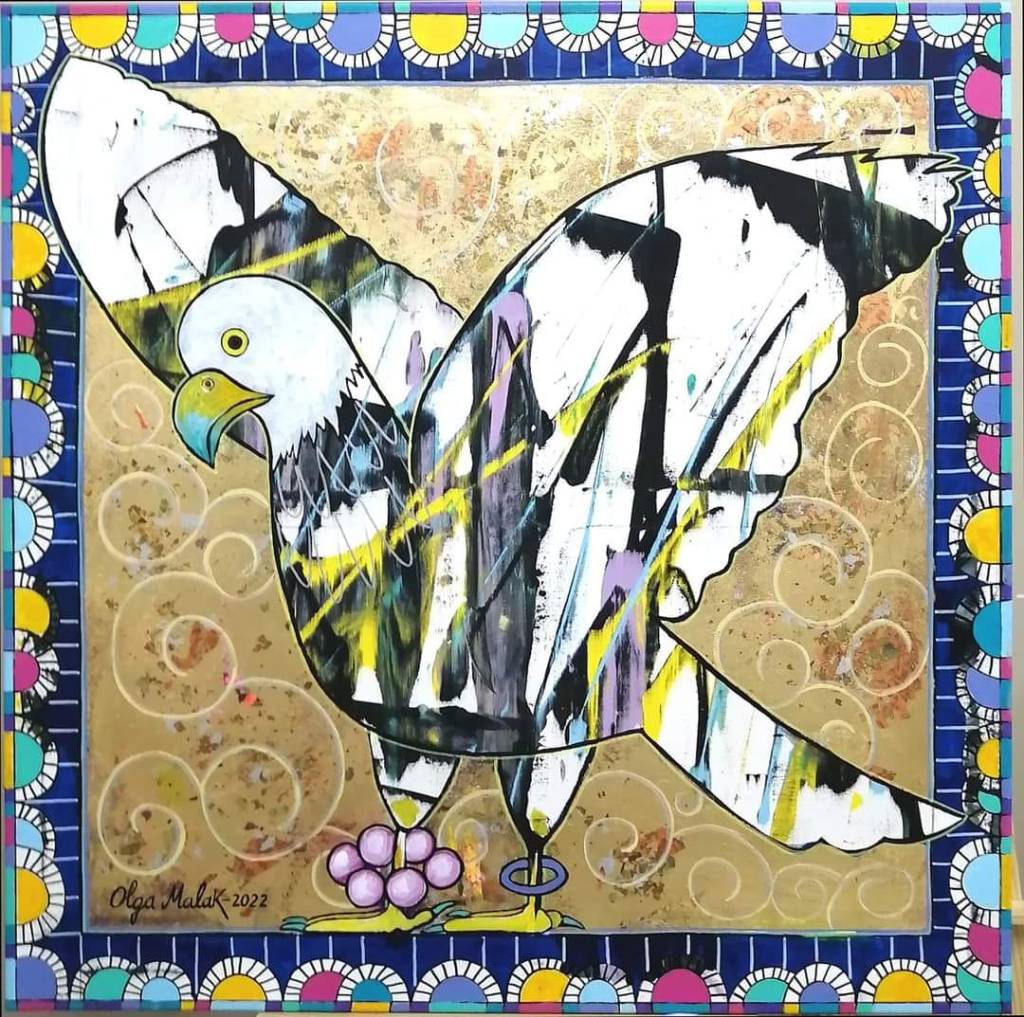
Dense narrative compositions in acrylic and mixed media integrating:
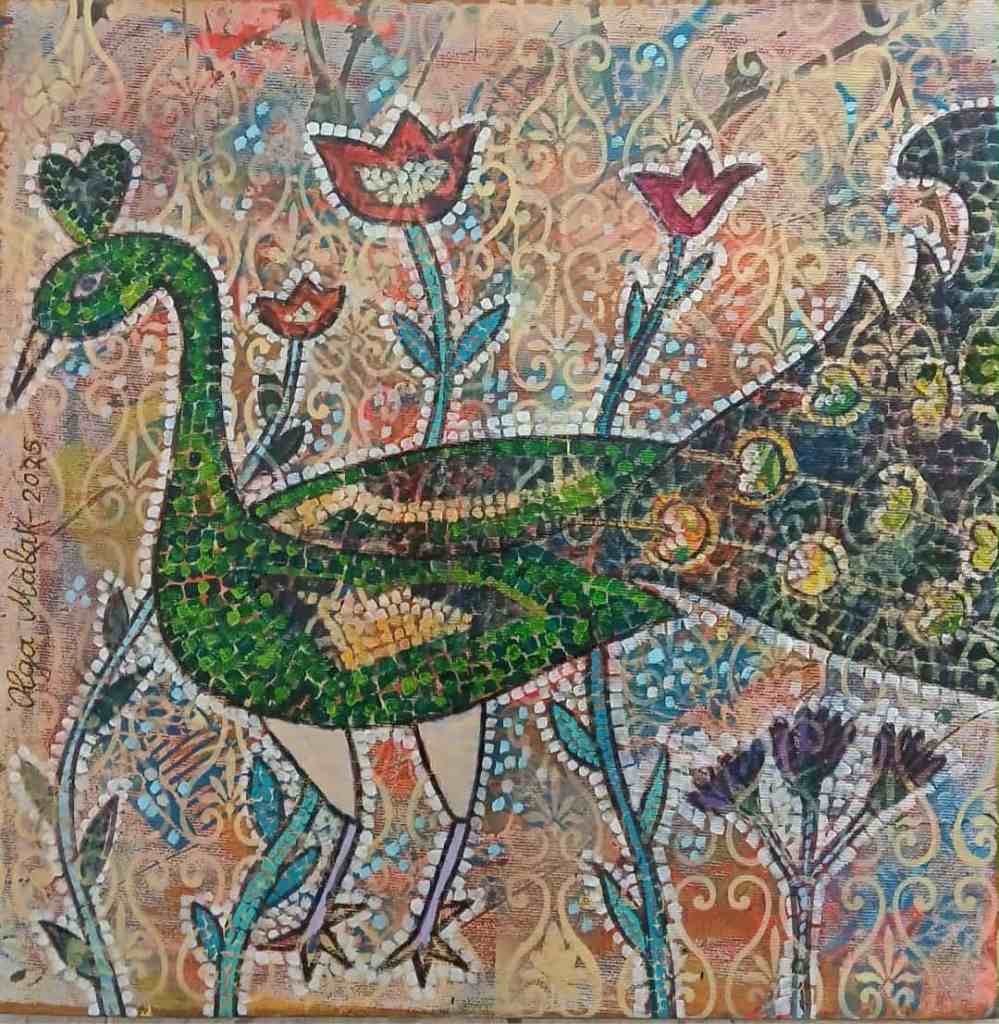
- Roman mosaic tesserae
- Qallaline ceramic tiles
- Ancient pottery motifs
- Ancestral Berber signs
Increasingly complex backgrounds — Result of multiple superimposed layers, scraping, glazing, ornamental patterns, sometimes enhanced with gold leaf using Byzantine techniques
Symbolic bestiary:
- Domestic felines
- Colorful birds
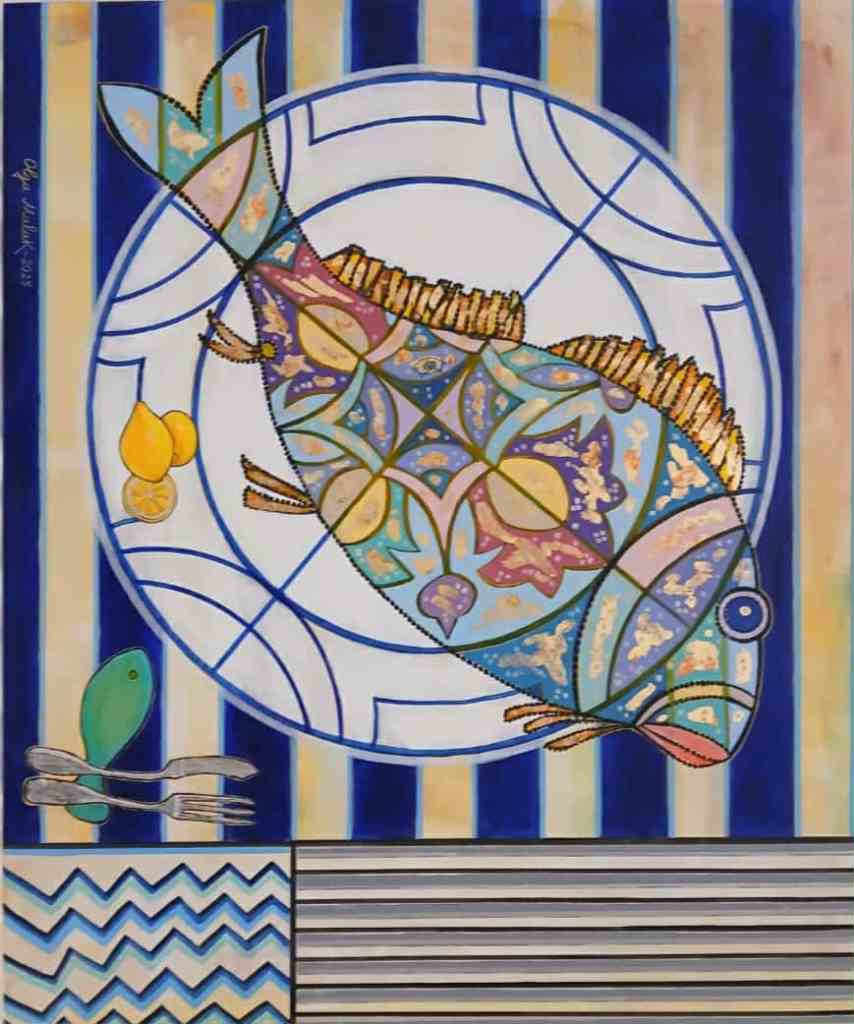
- Stylized fish
- Graceful equines
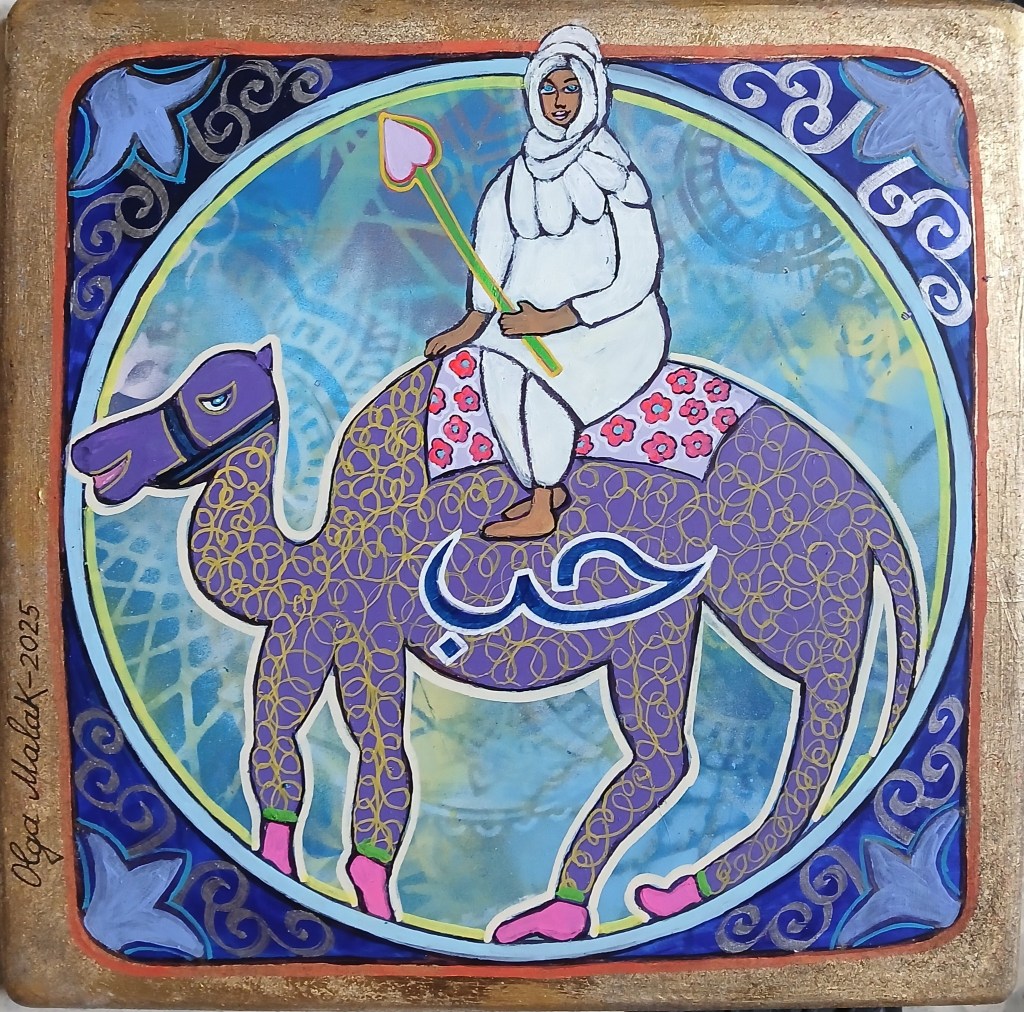
- Desert camels
Archetypal feminine figures — Embodying the permanence of Tunisian femininity through history
Solar chromatic palette — Evoking harsh southern light, warm ochre earth tones, deep Mediterranean blues
The Cat: Her Iconic Signature
« There’s always a cat in each painting, inserted playfully and which I consider ‘my signature.’ »
« Sometimes it hides, but it’s a constant and constitutes for me a symbol of love for nature and an ode to woman and a whole playful game. »
Present in almost every composition, this discreet but recurring feline constitutes:
- A visual game with the viewer
- A poetic « Where’s Waldo? »
- The storyteller’s alter ego
- A metaphor for permanence itself
The Technique: Building Worlds « Brick by Brick »
Meticulous Construction
Each Malakhova painting is constructed patiently « brick by brick » with a size 0 brush — the finest precision tool — to make it a world rich in patterns, vivid colors, and symbols.
« Each work is a challenge, and obsesses me until its completion. Some ‘give birth in pain.’ It’s only when I sign that I’m satisfied. »
« When I work, I lose track of time, I’m possessed. Sometimes I remain standing all day without eating. »
« I practice meditation before starting a work, to find the subject, and also after to add details, harmony. Sometimes I remove details to achieve perfect harmony. It’s a fight for construction, to feel each element. »
Format Range
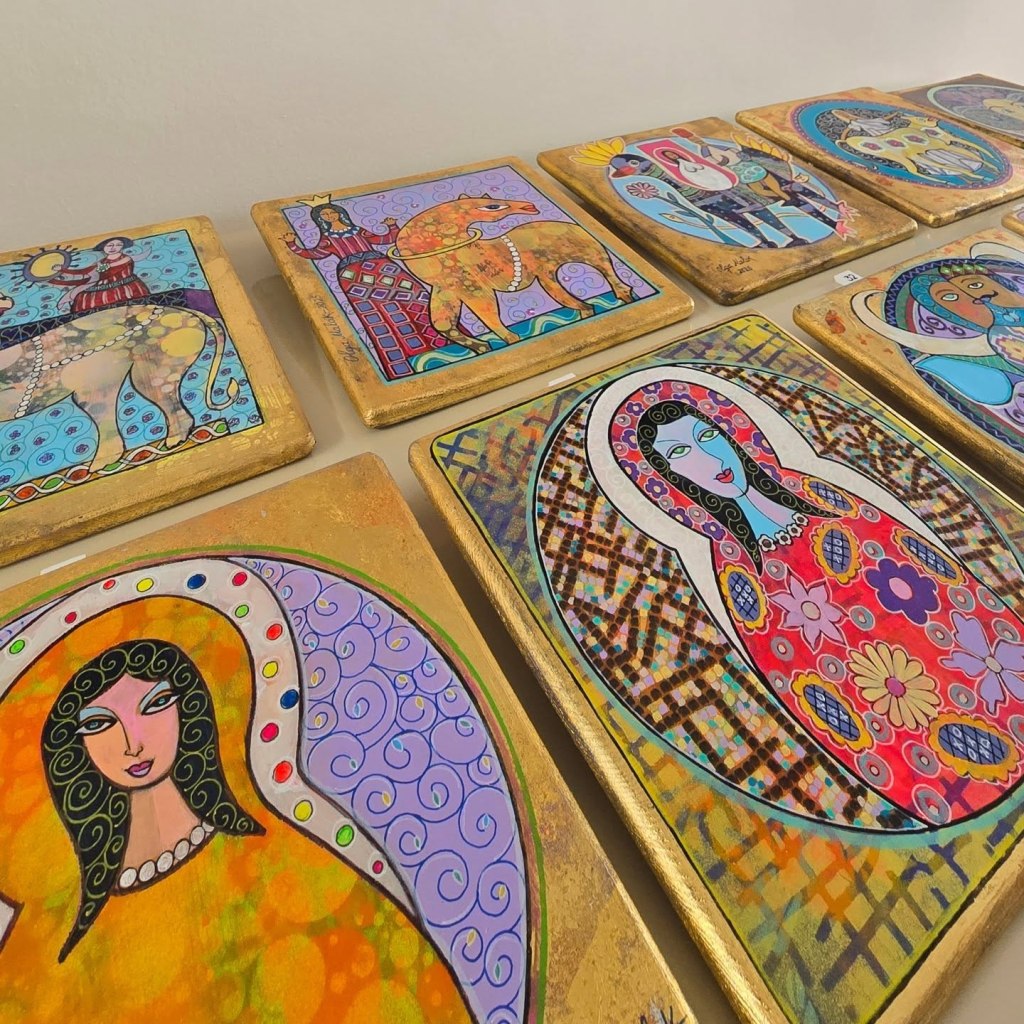
Small formats (12×12″ or 16×16″) — Often on prepared wood panel, considered « contemplative pauses » between major compositions, allowing bold chromatic experimentation
Medium formats (around 32-40″) — Ideal balance between compositional ambition and technical manageability
Large formats (up to 51×51″) — Monumental and demanding, these paintings impose a spectacular, immersive presence
Recent innovation: « This time I used wood technique on large formats, which is new, for an 31″ diameter. »
Mixed Media & Gold Leaf
Malakhova « uses mixed techniques to materialize her works between oil painting, acrylic, and cuttlefish ink and coffee. »
The use of gold leaf — technique inherited from Byzantine art and Orthodox icons — appears in certain works to:
- Enhance iconographic details
- Create luminous halos
- Establish precious backgrounds
- Bridge Eastern tradition and Mediterranean heritage
Increasingly Complex Backgrounds
Unlike her early compositions with relatively neutral backgrounds, Malakhova’s recent works present complex, richly elaborated backgrounds.
These backgrounds become active spaces, worked through:
- Superimposed layers
- Scraping
- Glazing
- Ornamental patterns
- Sometimes gilding
This sophistication creates ambiguous spatial depth, recalling the spatial solutions of ancient mosaics.

The Link to Naïve Art
Spontaneity Meets Scholarship
Art critics situate Malakhova’s work « at the heart of Tunisian naïve art enriched by a Russian iconic touch. »
Like naïve art masters, she cultivates:
- Appearance of joyful spontaneity
- Decorative profusion
- Compositional freedom
- Escape from academic canons
« At times, it’s explosion that dominates, the perception of an improbable plastic universe, situated between Douanier Rousseau and Frida Kahlo, » notes one critic.
Disguised Erudition
Yet unlike self-taught naïve artists, Malakhova possesses:
- Solid academic training
- Extensive artistic culture
- PhD in aesthetics
- Published research
She consciously integrates « some ‘homage’ touches » to masters she admires: Paul Klee, Kandinsky, Klimt, Ali Ben Salem, Jalel Ben Abdallah, Abdelaziz Gorgi.
This tension between apparent spontaneity and scholarly construction defines her unique style: cultivated naïve art, where each decorative element hides a documented heritage reference, where each joyful composition rests on months of museum research.
« Malakhova proves that her own gaze is profoundly Tunisian, that is to say kneaded by tradition and moved by a structuring approach. »
Recurring Themes: Love, Legend, and Legacy
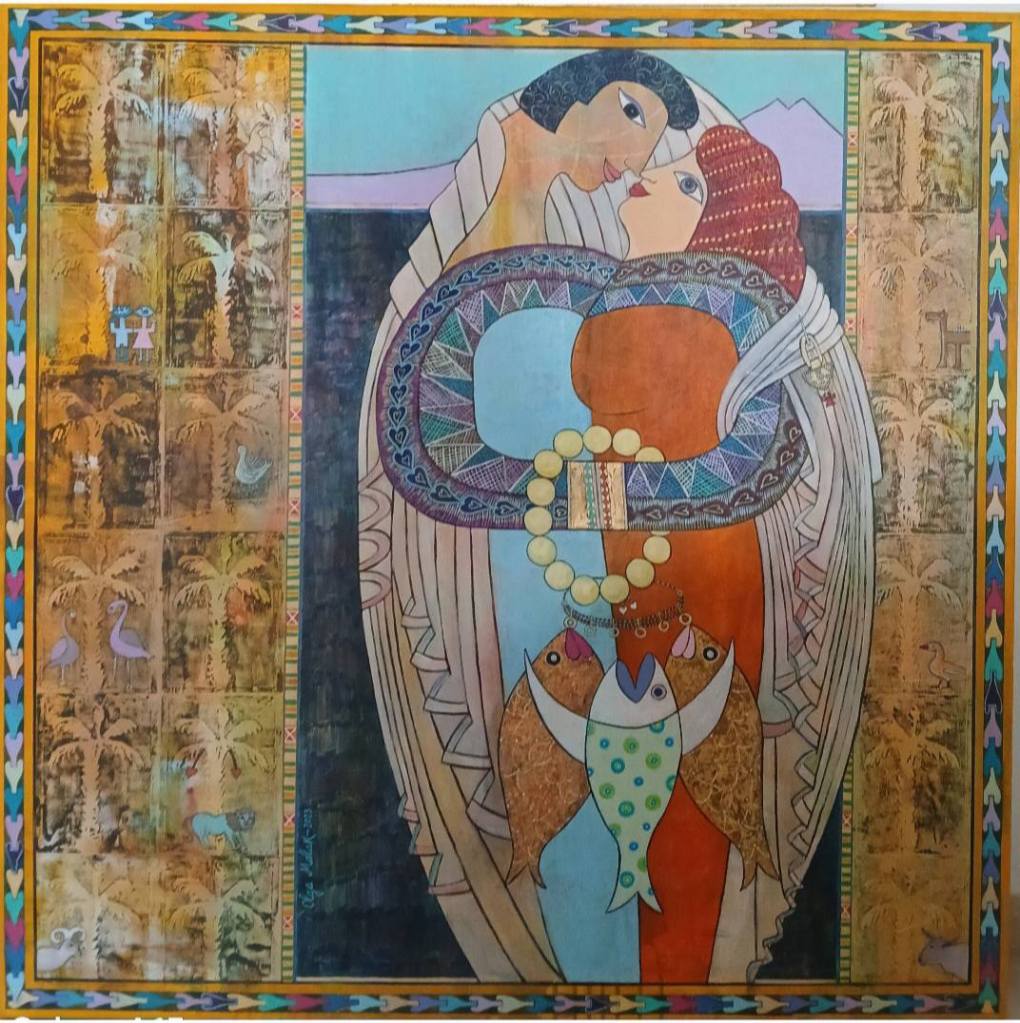
Mythological Couples: Dido and Aeneas
One of Malakhova’s most fascinating themes is her exploration of legendary couples from Tunisian history.
Her current exhibition « The Beauties of Carthage » pays « tribute to Dido and Aeneas, Elyssa and others. »
The myth: Dido (Elyssa in Phoenician), fugitive Phoenician queen who founds Carthage and falls in love with Trojan hero Aeneas, before being abandoned and taking her own life.
This tragic couple embodies:
- Meeting between Phoenician East and Mediterranean world
- Passionate love versus political destiny
- Founding narrative of Carthage
In her canvases, Malakhova reinvents these legendary figures, adorning them with visual attributes gleaned from her Bardo research: mosaic tesserae, Roman drapery, Punic symbols.
The « Lady Elyssa » Collection
For her « Lady Elyssa » project, she prepared « a collection of 21 paintings including 7 large formats, 7 medium formats and 7 small formats. »
This ambitious project, realized in collaboration with writer Hatem Bourial, aimed to « revisit Tunisian heritage » through the legendary figure of Elyssa.
« I provide the images and the writer creates the texts, it’s a four-handed project. The person of Elyssa created by me and narrated by the writer. »
This collaborative approach perfectly illustrates her role as visual storyteller: image and text dialogue to construct a complete narrative.
The Permanence of Tunisian Femininity
Beyond mythological figures, Malakhova explores what she calls « the permanence of Woman » across ages.
Her exhibitions bear revealing titles: « Tribute to Woman, » « The Permanence of Woman », with works titled « The Carthaginian Woman, » « Woman Waiting. »
« This woman is simply the Tunisian woman. She belongs, moreover, to the several-thousand-year history of Tunisia and its civilizations ranging from Capsian to Carthaginian. »
She explains: « My first time in Tunisia, I thought the man was most important. Afterwards, I discovered that woman was the center of everything, the generating motor of society. »
This theme of feminine permanence runs through her entire work: from Punic goddess Tanit to contemporary women, passing through Roman matrons in mosaics and Berber artisans, Malakhova weaves continuity, showing that despite changing civilizations, Tunisian women have always been at society’s heart.
Tribute to Tunisian Jewish Heritage
Malakhova has also created a tribute series to Tunisian Jewish heritage, including « Lady Ghriba, » a composition of 7 paintings.
This openness to all components of Tunisian heritage testifies to her will as comprehensive storyteller, embracing the cultural and religious diversity that makes Tunisian history rich.
Major Exhibitions: Chronicles of Heritage
« The Beauties of Carthage » (2025)
Currently showing through November 12, 2025
Espace Imagin’, Carthage Dermech
48 works
Inspired by the « Lady of Carthage » mosaic, this exhibition pays tribute to Dido, Elyssa, and Carthaginian women.
« I saw this mosaic long ago, but it was a pretext that inspired me to revive it knowing it’s not currently exhibited, because ancient and contemporary heritage fascinates me and constitutes a source to reread the past, reinvent it and paint new forms with new ideas. »
Featured works include:
- « Hout alik » (« Fish for you »)
- « Weld Bhar » (« Son of the sea »)
Humorous nods to ancient and contemporary heritage.
« Femina Sapiens » (2023)
Galerie Saladin, Sidi Bou Said
This exhibition « pays tribute to woman, but also to life and love. »
It marks a stylistic turning point with « the appearance of white background for the first time in some of her paintings. »
The exhibition required nine months of work — « nine months recalling gestation time in women to give birth to their child. One painting even bears the title ‘Maternity.’ »
Notable works include:
- « Cat on Scooter »
- « The Pasha and the Dolls »
- « Bull in Hula Hoop »
Testifying to the « touches of humor » present in her work.
« Lady Elyssa » (2019)
Espace Elyssa Artisanat
21 paintings in collaboration with writer Hatem Bourial honoring the legendary princess of Carthage.
Tribute to Stanislav Malakhov (2020)
Palais Kheïreddine, Tunis Medina
An exceptional exhibition under the high patronage of the City of Tunis, « Stanislav Malakhov, Daughter and Friends » — a vibrant pictorial homage to her father, reuniting contemporary artists from former Soviet Union countries.
The Artistic Philosophy: Joy Through Depth
Permanence Over Rupture
Unlike many contemporary artists who privilege rupture, contestation, or deconstruction, Malakhova chooses to celebrate permanence:
- Permanence of traditions
- Permanence of know-how
- Permanence of symbols
- Permanence of founding myths
Her work doesn’t seek to overturn but to transmit, to dialogue across eras, to show continuity despite changing civilizations.
The Art of Visual Storytelling
« Through her work, Olga Malakhova is a passer of memory and emotion. »
She doesn’t just paint historical subjects — she tells stories, transmits collective memory, revives forgotten myths.
Each painting becomes a chapter in a vast narrative fresco where Tunisian heritage, from Punic era to present, finds new pictorial life.
Joy Rooted in Depth
« My works sing joy and happiness. People who come see my exhibition must leave with a smile and good mood, that’s all my satisfaction! »
But this joy isn’t superficial. It’s born from:
- Documentary depth
- Assumed erudition
- Intimate connection with heritage
- Understanding through research
It’s the joy of one who understands, who knows, who can transmit. A storyteller’s joy who knows her stories and takes pleasure sharing them.

Critical Reception & Recognition
Immediately Recognizable Style
« For years, people can recognize my works without them being signed with my name, » Malakhova states proudly.
This immediate recognition testifies to the affirmation of a strong, coherent pictorial identity.
Scholarly Naïve Art
Critics situate her work « at the heart of Tunisian naïve art enriched by a Russian iconic touch, » evoking « Douanier Rousseau and Frida Kahlo. »
But they also recognize she « knows how to integrate influences » and that « her own gaze is profoundly Tunisian, that is to say kneaded by tradition and moved by a structuring approach. »
Institutional Recognition
Several major works have been acquired by the Tunisian State, including « Lady Elyssa, » testifying to institutional recognition of her role as guardian and storyteller of national heritage.
Collections
Malakhova’s works figure in numerous public and private collections, in Tunisia and abroad, testifying to growing recognition among:
- Contemporary Mediterranean art collectors
- Narrative art enthusiasts
- Heritage art specialists
Her Influences: A Cultural Crossroads
Masters of the Tunis School
Malakhova follows in the lineage of pioneers of Tunisian pictorial modernity. Her work evokes « Ben Salem’s dexterity, Z. Turki’s stylization, and A. Megdiche’s esotericism. »
She particularly admires:
Aly Ben Salem (1910-2001) — Master of light and popular scenes
Jellel Ben Abdallah (1921-2017) — Virtuoso of revisited miniature
Zoubeir Turki (1924-2009) — Poet of Mediterranean space
Abdelaziz Gorgi (1928-2008) — Expressionist colorist
« From Gorgi to Dhahak passing through Guermassi, Malakhova knows how to integrate the influences we all carry, » but she deliberately emancipates herself from stylistic mimicry to propose a very personal pictorial writing.
International References
Among her inspiration sources are masters who explored the Orient:
Paul Klee — Who sojourned in Tunisia in 1914 and discovered pure color there
Gustav Klimt — Whose use of gold leaf and Byzantine ornamental patterns resonate in certain Malakhova compositions
Wassily Kandinsky — Theorist of abstraction and the spiritual in art
The artist has published a scientific article on « The Fusion of Europe and Orient in Paul Klee’s Work, » testifying to her deep knowledge of these cultural dialogues.
Millennial Tunisian Heritage
Malakhova’s pictorial universe draws generously from historical layers of Tunisian heritage:
Punic-Carthaginian period — Punic steles and Carthaginian art, particularly representations of goddess Tanit and Phoenician iconography
Roman antiquity — Bardo mosaics, « notably that of Virgil and his Muses, » constitute a major reference
Byzantine heritage — Orthodox icons and Byzantine art, inherited from her Estonian education
Amazigh Berber traditions — Ancestral geometric signs, traditional feminine tattoos, carpet textile motifs
Urban craftsmanship — Chemla ceramics, Qallaline tiles nourish her chromatic palette

Why Collect Malakhova
Artistic Merit
Each piece represents:
- Decades of technical mastery
- Unique scholarly-creative vision
- Museum-documented research
- Impeccable craftsmanship
Investment Value
Malakhova’s work offers collectors:
Narrative uniqueness — Stories preserved and transmitted through paint
Documentary authenticity — Every symbol has historical provenance
Cultural significance — Bridges ancient Carthage and contemporary Tunisia
Institutional validation — State acquisitions confirm artistic importance
Growing recognition — Limited availability as reputation expands internationally
Supporting Living Heritage
When you acquire Malakhova’s work, you’re:
- Preserving Tunisian cultural memory
- Supporting scholarly artistic research
- Investing in Mediterranean heritage art
- Connecting with millennia of history
Glossary: Understanding Malakhova’s Universe
Technical Terms
Acrylic — Synthetic resin-based paint favored by Malakhova for rapid drying, chromatic luminosity, and versatility in complex narrative compositions
Mixed media — Strategic layering of heterogeneous mediums (acrylic, cuttlefish ink, coffee, collage) on same pictorial surface to create varied texture effects
Gold leaf — Fine gold pellicle applied using Byzantine techniques to enhance details, create luminous halos, or establish precious backgrounds
Size 0 brush — Extremely fine precision brush used for meticulous « brick by brick » construction of dense compositions
Complex worked backgrounds — Sophisticated backgrounds resulting from multiple successive interventions (superimposed layers, scraping, glazing, ornamental patterns, sometimes gilding)
Heritage Terms
Dido/Elyssa — Legendary queen founder of Carthage. Fugitive Phoenician princess from Tyre who cleverly purchases territory (oxhide legend), founds Carthage, becomes tragic lover of Aeneas in Virgil’s Aeneid
Aeneas — Trojan hero, son of Anchise and Venus, fleeing burning Troy. According to Virgil, he stops at Carthage where Dido falls in love with him
Tanit — Principal goddess of Carthaginian Punic pantheon, city protector, represented by stylized geometric symbol
Punic stele — Vertical votive monument in carved stone, typical of Carthaginian civilization, bearing Phoenician inscriptions and religious symbols
Virgil and His Muses mosaic — 3rd-century Roman mosaic at Bardo Museum, representing poet Virgil surrounded by Clio (Muse of History) and Melpomene (Muse of Tragedy)
Tessera — Small cube of stone, marble, or colored glass paste constituting elementary unit of ancient mosaic
Conceptual Terms
Visual storyteller — Central concept defining Malakhova’s approach: not simply representing but telling stories through images, transmitting founding narratives
Permanence — Philosophical thread since 2015: continuity of traditions, symbols, founding myths across centuries despite changing civilizations
Tribute to the past — Recurring theme of revisiting ancient eras (Punic, Roman, Byzantine) with active transmission rather than nostalgia
Documentary research — Fundamental methodology: regular museum visits, mosaic and terracotta study, scientific publication consultation
Frequently Asked Questions
Who is Olga Malakhova?
An Estonian-born, Tunisia-naturalized painter-researcher with a PhD in aesthetics from Paris 8. Since 1987 in Tunisia, she creates narrative paintings in acrylic and mixed media, sometimes enhanced with gold leaf, based on systematic documentary research in museums. She teaches at the Higher Institute of Childhood Executives in Carthage.
What defines Malakhova’s style?
Narrative figuration meeting ornamental symbolism, close to Tunisian naïve art by apparent spontaneity but scholarly constructed. Acrylic and mixed media compositions, sometimes gold leaf enhanced, feature increasingly complex backgrounds. Recurring themes: legendary couples (Dido and Aeneas), tribute to ancient past, permanence of traditions.
What is her research approach?
Malakhova regularly visits Bardo Museum and Sousse Museum to study Roman mosaics, ancient terracottas, Punic steles. She consults scientific publications on Tunisian heritage. This rigorous documentation feeds her role as visual storyteller: each painting becomes a visual narrative where past dialogues with present.
How does she relate to naïve art?
Critics place her at the heart of Tunisian naïve art, evoking Douanier Rousseau and Frida Kahlo. Like naïve art, her compositions present decorative profusion, compositional freedom, and apparent spontaneity. But unlike self-taught naïve artists, she has solid academic training and extensive culture. Her art is « cultivated naïve »: apparent spontaneity scholarly constructed.
What are her recurring themes?
Legendary couples (particularly Dido and Aeneas, Carthage’s founding mythic couple), tribute to past (Punic, Roman, Byzantine eras), permanence of Tunisian woman across ages, transmission of collective memory. She also explores Tunisian Jewish heritage (Lady Ghriba series).
Why is there always a cat in her paintings?
The cat has become her iconic signature. Present in almost every work, sometimes hidden, it constitutes a playful game with the viewer. Beyond play, the cat symbolizes permanence and observation: like the storyteller, it observes passing centuries while maintaining immutable nature — perfect metaphor for tradition continuity her work celebrates.
What techniques and materials does she use?
Malakhova works primarily in acrylic and mixed media on canvas or wood panel. She combines different mediums: acrylic, cuttlefish ink, coffee, and sometimes gold leaf applied using Byzantine techniques. Recent compositions present increasingly complex worked backgrounds, result of multiple layers, scraping, and glazing. She meticulously constructs paintings « brick by brick » with size 0 brush.
What is her current exhibition?
Through November 12, 2025, « The Beauties of Carthage » presents 48 acrylic and mixed media works at Espace Imagin’, Carthage Dermech. Inspired by « Lady of Carthage » mosaic, the exhibition pays tribute to legendary couple Dido and Aeneas and women of Carthaginian antiquity, illustrating her role as storyteller of Tunisian founding myths.
Where can I acquire her work?
Original works available through ArtNova Gallery’s curated collection, partner galleries in Tunisia (Espace Imagin’, Galerie Saladin), and directly from the artist. All works come with certificates of authenticity.
Connect & Collect
Acquire Original Works
ArtNova Gallery — Exclusive Collection
Curated selection of Malakhova’s narrative paintings
Small, medium, and large formats available
Certificate of authenticity included
International shipping arranged
Current Exhibition
« The Beauties of Carthage »
Through November 12, 2025
Espace Imagin’
26 rue Pline, Carthage Dermech, Tunisia
Tel: +216 98 305 125
Saturday 10am-1pm & 2:30-6:30pm
Other days by appointment
Museum Resources
Bardo National Museum — Where Malakhova conducts research
Sousse Archaeological Museum — Regular research site
Museum of Modern and Contemporary Art — Tunis
Academic Publications
From Painting to Installation: The Construction of Landscape in Tunisia (Doctoral thesis, ANRT, 2020)
Heritage and Contemporaneity: An Identity Equation in Cultural Production (Edited volume, 350 pages, 2015)
« The Fusion of Europe and Orient in Paul Klee’s Work » (Scientific article, 2011)
The Final Word: Memory Keeper, Story Weaver
Olga Malakhova represents something rare in contemporary art: the scholar-storyteller who combines documentary rigor with creative freedom, heritage erudition with narrative spontaneity.
Coming from Estonia over thirty-five years ago, she’s made Tunisia not only her artistic homeland but the very subject of her transmission work.
Her practice doesn’t limit itself to aesthetic representation: each painting tells a story, each composition weaves links between eras, each detail references documented sources.
In this sense, Malakhova is truly a visual storyteller who perpetuates orally — but visually — Tunisia’s founding narratives.
Her methodical museum research, assiduous consultation of reference works, and meticulous attention to iconographic details make her an active heritage guardian. But unlike passive conservation, she reinvents, revives, transmits these heritage treasures through an accessible, joyful pictorial language close to naïve art by its apparent spontaneity.
The themes she explores testify to her will to show not rupture but continuity, not forgetting but living memory.
In a contemporary world often turned toward novelty and rupture, Malakhova reminds us of the value of:
- Permanence
- Transmission
- Rootedness
- Collective memory
Her canvases in acrylic and mixed media, with increasingly complex worked backgrounds, sometimes enhanced with gold leaf, aren’t mere decorative objects: they’re pictorial storybooks, visual narratives that preserve and transmit Tunisia’s millennial collective memory.
Discovering Malakhova’s works on ArtNova Gallery means entering a narrative universe where each painting tells Tunisia’s story, from ancient Carthage to today, where tradition permanence dialogues joyfully with modernity.
Take Action
🎨 Explore the Collection
View Olga Malakhova works on ArtNova Gallery →
Acquire an original narrative painting in acrylic and mixed media, sometimes gold leaf enhanced, that tells a story of Tunisia’s millennial heritage and celebrates the art of visual storytelling.
📅 Visit the Current Exhibition
Don’t miss « The Beauties of Carthage » — tribute to Dido and Aeneas — through November 12, 2025 at Espace Imagin’, Carthage Dermech.
📧 Stay Informed
Follow Malakhova’s latest documentary discoveries, exhibition announcements, and new creations via CAPSA: Art and Culture association.
🎁 Gift a Story
Malakhova’s original works make exceptional, meaningful gifts. Each painting tells a heritage story, transmits collective memory, celebrates tradition permanence. Ideal for narrative art lovers, Mediterranean heritage collectors, or anyone sensitive to history and transmission.
About This Article
This comprehensive reference article on painter and visual storyteller Olga Malakhova was written with constant concern for historical accuracy and documentary precision.
Biographical, methodological, and aesthetic information comes exclusively from verified and cross-referenced sources: direct artist interviews, specialized art criticism press, documented exhibition catalogs, artist’s scientific publications, and official institutional sites.
Emphasis placed on her researcher-storyteller approach, in-depth documentary research in Tunisian museums, link to naïve art, and recurring themes (legendary couples, tribute to past, permanence).
Last documentary update: November 2025
Article prepared for ArtNova Gallery — Your destination for discovering and acquiring contemporary Mediterranean art where each painting tells a story.

Laisser un commentaire